Managing money effectively isn’t about being a math genius or living on a bread-and-water budget. At its core, income management is about taking control of what comes in, understanding where it goes, and using it to build a life where you aren’t constantly checking your bank balance with a pit in your stomach.
Whether you’re earning a steady paycheck, working as a freelancer with fluctuating income, or trying to figure out why your hard-earned money seems to evaporate by the third week of the month, this guide is for you. We will walk through everything you need to know about managing your earnings, maximizing your pay, and setting yourself up for long-term financial freedom.
What Is Income Management and Why Does It Matter?
Income management is the system you put in place to handle every dollar you earn. It covers how you split your earnings between daily expenses, debt payoff, savings, and long-term investments.
Without a plan, money tends to follow the path of least resistance: it gets spent. Good income management flips the script. Instead of wondering where your money went at the end of the month, you give every dollar a specific job before it even hits your account.
When you master this skill, you gain three major advantages:
- Stress Reduction: You always know your bills are covered.
- Preparedness: An unexpected car repair or medical bill won’t throw your life into chaos.
- Growth: Your money works for you over time through compound interest and strategic investments.
Understanding Your Paycheck: Gross Income vs Net Income
Before you can manage your money, you need to know how much you actually have to work with. Understanding Gross vs Net Income is essential, as one of the most common early financial missteps is building a budget around your gross income rather than your net income.
Gross Income: This is the total amount of money you earn before any taxes, benefits, or deductions are taken out. If an employer offers you a salary of $60,000 a year, that $60,000 is your gross income.
Net Income: Also known as your take-home pay, this is the actual amount that lands in your bank account on payday. This is the only number you should use when creating your budget.
Understanding Salary Deductions
When you look at your pay stub, you’ll notice a gap between your gross and net pay. That gap consists of several standard deductions:
- Income Taxes: Federal, state, and local taxes withheld by your employer based on tax brackets and allowance forms.
- Payroll Taxes: Contributions toward programs like Social Security and Medicare.
- Health and Welfare Benefits: Your contribution toward health insurance, dental coverage, or life insurance offered by your job.
- Retirement Contributions: Pre-tax or post-tax contributions to employer-sponsored plans like a 401(k) or 403(b).
Understanding these line items helps you evaluate whether your tax withholdings are set correctly and ensures you aren’t paying for benefits you don’t use.
Base Salary vs Total Compensation Package
When evaluating your overall financial standing, focusing solely on base salary gives an incomplete picture. Smart income management involves looking at your total compensation package.
Total compensation includes your base pay plus the monetary value of all additional benefits provided by your employer. A job offering a base salary of $70,000 with comprehensive benefits might actually be far more valuable than a job offering $78,000 with no benefits at all.
Total Compensation = Base Salary + Bonuses + Health Benefits + Pension Match + Perks
Consider employer retirement matching. If your employer offers a 5% matching contribution on a $60,000 salary, that is $3,000 in free money poured directly into your long-term wealth every year.
Other key components of a total compensation package include paid time off, performance bonuses, health insurance coverage, stock options, and professional development allowances. Factoring these benefits into your overall financial plan gives you a much clearer view of your true financial strength.
How Income Affects Financial Planning
Your income level naturally dictates the scale of your immediate financial plans, but it shouldn’t dictate your financial discipline. Whether you earn $30,000 or $300,000 annually, the principles of income management remain identical; only the scale changes.
Higher earnings allow you to accelerate goals like buying a home, retiring early, or investing in higher-yield assets. However, earning more money doesn’t automatically build wealth.
If your spending rises at the exact same rate as your earnings a phenomenon known as lifestyle creep, a higher income won’t bring you any closer to financial security. True security comes from the gap between what you earn and what you spend.
Active Income vs Passive Income
To build long-term wealth, it helps to diversify how your money comes to you. Broadly, income falls into two categories: active and passive.
Active Income
This is money earned in direct exchange for your time and labor. If you stop working, the income stops. Examples include:
- Hourly wages and monthly salaries
- Freelance design or writing fees
- Sales commissions and tips
Passive Income
This is earnings derived from assets that continue to generate cash flow after the initial effort or investment is made. While rare to find something truly 100% hands-off, passive sources require minimal ongoing labor. Examples include:
- Dividends from stock investments
- Rental income from real estate
- Royalties from books, software, or digital products
- High-yield savings account interest
Most people start with 100% active income. The goal of financial planning is to gradually use your active income to purchase assets that generate passive income, eventually giving you complete time freedom.
Ways to Increase Your Income
While cutting expenses is helpful, there is a limit to how much you can save. There is no limit, however, to how much you can earn. Boosting your primary earnings is one of the fastest ways to accelerate your financial goals.
Here are proven strategies to grow your main income source:
- Upskill and Certify: Identify high-demand skills in your industry and earn relevant certifications. Specialized knowledge commands higher salaries.
- Negotiate Your Raise: Prepare a summary of your achievements, impact on company revenue, and market rate data before your annual review.
- Switch Companies: Moving to a new company often yields a 10% to 20% pay increase compared to standard internal raises (which average around 3%).
- Seek Promotion: Step up for high-visibility projects and demonstrate your ability to handle higher-level responsibilities.
Exploring Side Income and Gig Ideas
If raising your main salary isn’t an immediate option, creating a side income (or side hustle) provides a fantastic way to pay down debt, build an emergency fund, or invest faster.
Side income provides a financial cushion: if your primary job disappears, you still have money flowing in.
Practical Side Income Ideas:
These are some side income ideas that can help you earn extra money alongside your main income. The right option depends on your skills, available time, resources and financial goals.
- Service-Based Freelancing: Offer skills like copywriting, graphic design, web development, or virtual assistance on platforms like Upwork or directly to local businesses. Earning potential: $25–$100+ per hour.
- Tutoring or Coaching: Teach subjects you excel at, or offer language lessons through online platforms like iTalki. Earning potential: $20–$50 per hour.
- E-commerce & Crafts: Create custom products, print-on-demand items, or curated goods on platforms like Etsy or Shopify. Earning potential: Variable.
- Pet Care and House Sitting: Use platforms like Rover to dog-walk or pet-sit in your neighborhood. Earning potential: $15–$40 per visit.
- Renting Capital Assets: Rent out a spare room on Airbnb, or rent out photography equipment or tools you rarely use. Earning potential: $100–$1,000+ per month.
How to Manage Irregular Income
Managing a fixed monthly salary is relatively straightforward. But if you’re a freelancer, commission-based salesperson, gig worker, or small business owner, your monthly income might fluctuate dramatically earning $6,000 one month and $2,000 the next.
Managing an irregular income requires a different approach to avoid the feast-or-famine stress cycle.
Calculate Your Baseline Living Cost
Determine the absolute minimum amount you need to survive each month. Cover basic essentials: rent or mortgage, utilities, basic groceries, minimum debt payments, and basic insurance. Let’s say this baseline is $3,000.
2. Set Up a “Hill-and-Valley” Account
Open a separate holding account for incoming paychecks. During “high earnings” months (when you make $6,000), transfer everything into this holding account.
3. Pay Yourself a Fixed Salary
Set up an automatic monthly transfer from your holding account to your personal checking account for your baseline needs ($3,000). In high-income months, the excess cash stays in the holding account. In low-income months (when you make $2,000), the holding account tops up the missing $1,000.
This strategy smooths out your income, turning a volatile cash flow into a predictable monthly paycheck.
Simple Income Management Frameworks
To keep your spending aligned with your goals, consider adopting a simple budgeting system. Here are two highly effective options:
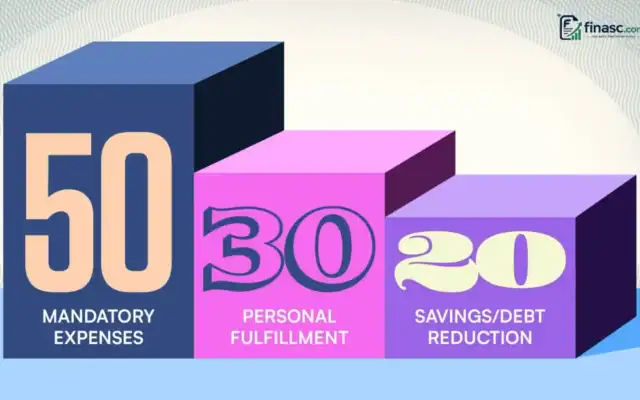
The 50/30/20 Rule
Popularized by Senator Elizabeth Warren, this rule splits your net (take-home) pay into three clear buckets:
- 50% Needs: Essential costs like rent, utilities, groceries, transport, and minimum payments.
- 30% Wants: Non-essentials like dining out, entertainment, subscriptions, and travel.
- 20% Savings & Debt Payoff: Contributions to emergency funds, retirement accounts, and extra debt payments.
Example: Applying 50/30/20 on a $4,000 Monthly Net Income
| Category | Percentage | Monthly Amount ($) | Included Expenses |
| Needs | 50% | $2,000 | Rent ($1,200), Groceries ($400), Utilities ($200), Transport ($200) |
| Wants | 30% | $1,200 | Restaurants ($400), Hobbies ($300), Subscriptions ($100), Vacations ($400) |
| Savings / Debt | 20% | $800 | Emergency Fund ($300), Roth IRA ($400), Extra Loan Payment ($100) |
| Total | 100% | $4,000 |
The Pay-Yourself-First System
If tracking percentages feels too tedious, try the “Pay Yourself First” approach. As soon as you get paid, automatically route a fixed percentage (e.g., 15%) directly into your savings and investment accounts.
Whatever money remains in your checking account is yours to spend freely on living expenses and wants, without guilt or complicated tracking.
Critical Traps to Avoid in Income Management
Even with a strong income, subtle habit traps can derail your progress. Keeping an eye out for these common behavioral missteps will protect your financial health:
Falling Prey to Lifestyle Inflation
As earnings increase, spending naturally rises to match. Upgrade your apartment, lease a pricier car, or order takeout more often, and you’ll find yourself living paycheck-to-paycheck on an $80,000 salary just as you did on $40,000.
Fix: Every time you get a raise or bonus, save or invest at least 50% of the raise before updating your lifestyle.
Budgeting Around Gross Earnings
Planning monthly expenses based on an annual salary before deductions leads to immediate overspending.
Fix: Build budgets solely on net cash deposited into your accounts.
Neglecting an Emergency Cushion
Without a liquid emergency fund (3 to 6 months of living expenses), any unexpected cost ends up on high-interest credit cards, undermining your financial plans.
Fix: Build a basic $1,000 starter safety net before paying down low-interest debt or focusing heavily on discretionary spending.
Treating Savings as an Afterthought
Saving whatever happens to be left over at the end of the month rarely works because spending expands to fill available cash.
Fix: Automate transfers to savings accounts on payday.
Actionable Steps to Take Control of Your Money Today
Taking control of your finances doesn’t require an overnight life overhaul. Start with these simple, actionable steps:
- Calculate Your Exact Net Income: Look at your last three pay stubs and find your true monthly take-home average.
- Track 30 Days of Spending: Use an app or spreadsheet to review where every dollar went over the last month. Group costs into basic categories.
- Automate Your Savings: Set up an automated transfer on payday moving cash straight into a high-yield savings account or index fund.
- Audit Unused Deductions and Subscriptions: Review your pay stub benefits and bank statements. Cancel recurring fees for services you don’t use regularly.
- Set One Specific Financial Goal: Pick a clear target like building a $3,000 emergency fund or paying off a $1,500 credit card balance and focus your momentum on it.
Final Thoughts
Income management isn’t about restricting yourself or cutting out every simple pleasure in life. It’s about intentionality. When you direct your cash flow purposefully, you eliminate financial anxiety and buy back your peace of mind.
Focus on the fundamentals: understand your real take-home pay, build a buffer for unexpected costs, consistently invest in passive income streams, and look for opportunities to raise your earning potential over time. Financial security is rarely created overnight, but with simple systems applied consistently, it is well within your reach.